

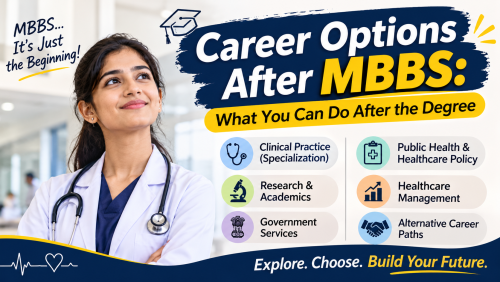
Career Options After MBBS: What You Can Do After the Degree
After MBBS and a one-year internship, most graduates choose between postgraduate training (MD, MS, DNB or a diploma), working as a general physician, or a non-clinical path such as public health, research or hospital management. The right choice depends on how much further study you want and what kind of work you want to do.
The main paths
| Path | What it involves | Typical next step |
|---|---|---|
| Clinical specialisation | MD or MS in a chosen specialty, or DNB, or a diploma | NEET PG and counselling |
| Super-specialisation | DM, MCh or DrNB after a PG degree | NEET SS |
| General practice or hospital work | Working as a medical officer, resident or family physician | Medical council registration, job applications |
| Government and defence services | State health services, Armed Forces Medical Services, PSU hospitals | Recruitment exams and selection boards |
| Public health and administration | MPH, MD in community medicine, hospital or health-system management | MPH or MBA admission, or PG entrance |
| Clinical research and pharma | Clinical trials, pharmacovigilance, medical affairs, regulatory work | Certification or industry entry roles |
| Academia and teaching | Faculty roles in medical colleges, usually after a PG degree | PG degree, then faculty recruitment |
| Practice abroad | Licensing in countries such as the US, UK or Australia | USMLE, PLAB or AMC pathways |
How to choose
- Start with the work you want to do. Hands-on patient care, procedures, diagnostics, research and policy lead to very different degrees.
- Check the entrance route early. Clinical PG runs through NEET PG, and seat competition varies a lot by specialty. Confirm current rules on the National Medical Commission (NMC) and NBEMS websites.
- Plan the time. A PG adds about three years, and a super-specialty adds roughly three more. Non-clinical routes can be shorter.
- Keep a fallback. Many graduates work as medical officers while preparing for PG exams.
Where this starts
All of these paths begin with an MBBS seat. If you are still choosing a college, see our guide to NEET counselling.
Next step: See our MBBS course page. For the PG stage, read our guide to MD MS admission after NEET PG 2026, visit the MD/MS page, or ask a counsellor.