


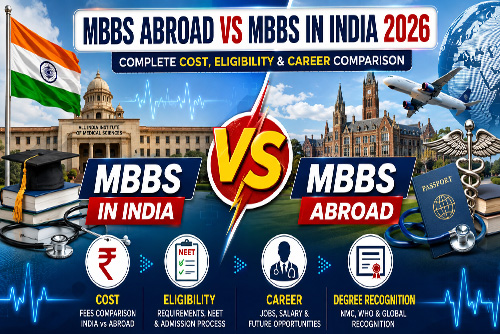
MBBS Abroad vs MBBS in India 2026: Complete Cost, Eligibility & Career Comparison
Every
year, lakhs of NEET-qualified students face the same dilemma: pay a steep price
for a private MBBS seat in India, or study abroad at a fraction of the cost.
Both paths lead to the same finish line — a medical license to practice in
India — but the journey, the investment, and the risks are very different.
Here's a clear, numbers-based comparison to help you and your family decide
with confidence.
1. NEET-UG Is Mandatory for Both Paths
Whether
you choose a private medical college in India or a university abroad,
qualifying NEET-UG is non-negotiable. For MBBS abroad, Indian students only need
to clear the minimum qualifying percentile — around the 50th percentile for
general category and 40th percentile for reserved categories — not a
competitive rank. Your NEET scorecard doubles as your eligibility certificate,
valid for three years, so there's no separate NMC eligibility certificate to
apply for.
For
a private seat in India, however, your actual rank matters a great deal, since
seats are allotted through state or All India counselling based on merit and
category.
Verify
current cutoffs and eligibility directly on the official NTA
NEET-UG portal before applying
anywhere.
2. Cost Comparison: Where the Real Gap Lies
This
is usually the deciding factor for most families. Here's how the numbers stack
up in 2026:
|
Factor |
MBBS in India (Private) |
MBBS Abroad |
|
Total course cost |
₹60 lakh – ₹1.5 crore+ |
₹15 lakh – ₹45 lakh (approx.) |
|
NEET requirement |
Required, with a competitive
cutoff |
Required, only the qualifying
percentile |
|
Course duration |
5.5 years (incl. 1-year
internship) |
Minimum 5.5–6 years (54 months
academic + 12-month internship) |
|
Medium of instruction |
English |
Must be English-medium to be
NMC-compliant |
|
Licensing to practice in India |
NExT (replacing FMGE) |
Same NExT screening exam is
mandatory |
|
Clinical exposure |
High patient load, familiar case
profile |
Varies by country and
university; verify hospital tie-ups |
|
Seat availability |
Limited; high competition |
Comparatively easier at a lower
NEET score |
Government
medical colleges in India remain the most affordable option overall — often
under ₹5–8 lakh for the full course — but seats are extremely limited and
require a very high NEET rank. Once you move to the private and deemed
university segment, MBBS abroad becomes 50–80% cheaper for a comparable degree.
3. Course Duration and Structure
Both
paths now run on a similar timeline. Indian MBBS is a 5.5-year programme with a
compulsory 1-year rotating internship. Under the Foreign Medical Graduate Licentiate (FMGL) Regulations,
2021, MBBS abroad must include at
least 54 months of academic study plus a separate 12-month internship at the
same university — bringing the total to roughly 5.5–6 years as well. Programmes
that don't meet this duration, or that mix languages of instruction, put your
future licensing at risk.
4. The Return Pathway: NExT and Licensing
This
is where many families get caught off guard. A foreign MBBS degree is not
automatically valid in India. Every foreign medical graduate must clear the National Exit Test (NExT), which is replacing the earlier FMGE screening exam,
before they can register with the National Medical Commission (NMC) and legally practice.
Indian
MBBS graduates will also eventually take NExT as their final licensing exam, so
in the long run, both groups are converging on the same benchmark — but foreign
graduates historically have had a tougher pass rate, largely due to gaps in
NEET-aligned preparation and clinical exposure. Choosing an NMC-compliant
university with strong clinical training abroad meaningfully improves your chances
here.
5. Clinical Exposure and Learning
Environment
Government
and reputed private colleges in India generally offer very high patient
volumes, giving students broad hands-on exposure to conditions common in Indian
clinical practice. Abroad, exposure varies widely by country and university —
some offer excellent hospital tie-ups, while others fall short. If you're
considering MBBS abroad, verifying the teaching hospital, patient load, and
language of clinical training should be as important as checking the tuition
fee.
6. Which Option Should You Choose?
•
If you have a strong
NEET rank and can secure a government seat — take it. It remains the most
affordable, highest-exposure option in India.
•
If you can only access a
private/deemed seat in India costing ₹60 lakh or more, and your family's budget
is a real constraint, MBBS abroad at an NMC-compliant university can offer
significant savings.
•
If your priority is
staying close to home, familiar clinical settings, and a well-established
alumni network, private MBBS in India may be worth the premium.
•
In every case, verify
NMC compliance — course duration, medium of instruction, and internship
structure — before signing any admission offer, regardless of country.
Planning
ahead for postgraduate specialisation too? See our guide to MD/MS admissions in India
to understand the next step after MBBS.
Sources & Official References
•
National Medical Commission (NMC) — official regulator for medical education and
practice in India
•
NMC Rules & Regulations — FMGL
Regulations, 2021 — conditions a
foreign MBBS degree must meet for Indian licensing
•
NMC National Exit Test (NExT)
Regulations, 2023 — the licensing
exam every foreign and Indian medical graduate must clear
•
NTA NEET-UG Official Portal — NEET-UG registration, results, and eligibility
notifications