


The Clinical Exposure Gap in Ayurvedic Education — And How to Avoid It
Ask any BAMS (Bachelor of Ayurvedic Medicine and Surgery) graduate what surprised them most after joining a hospital or starting practice, and a surprising number will say the same thing: how little real patient contact they had during their course, compared to how much they expected. It's a complaint that comes up constantly in Ayurveda circles — students who can recite Charaka Samhita verses and identify herbs with precision, but who feel unprepared the first time they have to independently assess and manage a real patient.
This isn't a reflection of individual laziness or weak colleges alone. The clinical exposure gap in Ayurvedic education is a structural issue, shaped by how BAMS programs are designed, staffed, and regulated. Understanding why it happens — and how to avoid falling into the gap yourself — matters enormously for anyone currently pursuing or about to begin a BAMS degree.
The Structure of the BAMS Course Itself
A BAMS program runs five and a half years, including a mandatory one-year internship. On paper, that internship year is meant to deliver the hands-on training that earlier years lack. In practice, the first four and a half years are heavily weighted toward theory: Sanskrit texts, classical Ayurvedic principles, pharmacology, and pre-clinical and para-clinical subjects that leave comparatively little room for supervised patient interaction until much later in the course.
Much of the BAMS curriculum in the earlier years is theory-heavy, and clinical exposure is concentrated later in the course, particularly during the internship year — which can leave students with limited hands-on practice by graduation if their college's clinical infrastructure is weak. By the time clinical postings begin in earnest, many students have had years of theoretical grounding but very limited practice translating that knowledge into real diagnostic and treatment decisions.
Uneven Access to Teaching Hospitals
Not every BAMS college has an attached hospital with the patient volume needed to give every student meaningful, hands-on exposure. Some institutions have well-run teaching hospitals with a steady flow of patients across OPD and IPD settings; others have far smaller facilities where students mostly observe rather than participate. When a hospital doesn't have enough patient footfall or case diversity, students end up rotating through departments without ever building the repetition needed to develop real clinical confidence. This is one of the biggest reasons why choosing the right BAMS college — one with strong hospital infrastructure and consistent patient inflow — matters just as much as the course curriculum itself.
A Shortage of Clinical Faculty and Mentorship
Good clinical training depends on experienced physicians who are willing to actively teach at the bedside, not just supervise from a distance. Many colleges struggle with faculty shortages, particularly in core clinical departments like Kayachikitsa (internal medicine), Shalya Tantra (surgery), and Prasooti Tantra (obstetrics and gynaecology). Where faculty-to-student ratios are stretched thin, students often get passive observation instead of active, mentored case management — watching a senior physician work rather than being guided through the diagnostic and treatment-planning process themselves.
Integration Challenges Between Classical Ayurveda and Modern Clinical Practice
Ayurvedic education sits at an interesting crossroads: students are trained in classical diagnostic methods like Nadi Pariksha (pulse diagnosis) and Prakriti assessment, while also needing familiarity with modern diagnostic tools, lab investigations, and integrative treatment protocols used in contemporary hospital settings. Colleges vary widely in how well they bridge this gap. Some produce graduates who are fluent in both classical and modern clinical approaches; others leave students strong in theory but underprepared to function confidently in a modern healthcare environment, particularly when referring patients or collaborating with allopathic colleagues.
Regulatory and Accreditation Inconsistencies
The clinical training standards mandated by the National Commission for Indian Systems of Medicine (NCISM) set minimum requirements for hospital beds, patient load, and faculty ratios. But enforcement and actual on-ground quality vary between colleges and states. A college that technically meets accreditation minimums on paper doesn't always translate that into a genuinely rich clinical training environment. This inconsistency is exactly why researching a college's actual clinical infrastructure — not just its accreditation status — is essential before making an admission decision.
How Students Can Close the Gap
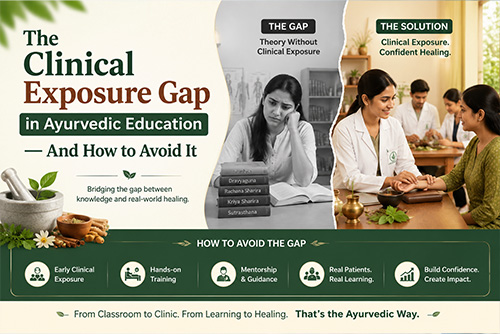
The good news is that the clinical exposure gap isn't inevitable. Students who take a proactive approach tend to graduate far more confident and job-ready:
- Choose colleges with strong attached hospitals. High patient volume and case diversity are non-negotiable for real clinical learning.
- Treat the internship year as the most important year of the degree, not a formality to get through quickly.
- Seek out mentorship actively rather than waiting for it — ask senior physicians to walk through their reasoning, not just their conclusions.
- Pursue additional clinical workshops, CME programs, and hospital observerships outside the standard curriculum where possible.
- Get informed guidance at the admission stage, since the college you choose has more influence on your clinical training quality than almost any other single decision.
This last point is where expert admission guidance becomes genuinely valuable. Doctors Academy India specialises in BAMS admission counselling across Kerala, Karnataka, Tamil Nadu, Andhra Pradesh, Pondicherry, and other states, helping students identify colleges with strong hospital infrastructure, reliable faculty ratios, and NEET-based or management/NRI quota pathways suited to their profile. Rather than choosing a BAMS college based on rank cutoffs alone, working with experienced counsellors helps students factor in the clinical training quality that will shape their entire career.
The Bottom Line
The clinical exposure gap in Ayurvedic education is real, but it isn't universal, and it isn't unavoidable. It stems from structural issues — course design, hospital infrastructure, faculty availability, and inconsistent enforcement of training standards — rather than any inherent flaw in Ayurveda as a discipline. Students who choose their BAMS college carefully, treat clinical postings and internship seriously, and seek out mentorship proactively can graduate with the confidence and competence the profession genuinely requires.